

- Get Involved
- …
- Get Involved
- Get Involved
- …
- Get Involved
WOMEN IN TECH
Women In Tech Program Brochure

About The Program
Women in Tech (WiT) is a unique program that aims to provide women with opportunities to learn skills such as analytics, programming, and coding. Through a series of online classes and resources, our goal is to empower women affected by conflict to pursue careers in the tech industry.
By empowering students through online classes featuring tutor-led instruction and ongoing mentorship, we hope to give women the skills and knowledge they need to succeed in a rapidly changing job market.
By participating in this program, you can take control of your future and build the career you deserve. We are proud to offer this program to women across the globe and look forward to supporting you as you learn and grow in the tech industry.
How It Works
1Apply
We share the student and volunteer application forms for the spring, summer, and fall semesters on social media and our website up to three times a year. Women in areas affected by conflict can apply to become students, and anyone with technical skills related to any of our courses can apply to become volunteers.
2Select
We select women who are at least 18 years old, are at the intermediate to advanced level of English proficiency, and show an interest in developing technical skills. The selection process consists of an application, an interview, and standard training. Only students who successfully complete all the steps before the deadline will be accepted into the program.
3Create
During each 10 to 14 week course, students are trained in technical and problem-solving skills and learn to develop solutions to various challenges. At the end of each course, students prepare to apply their skills and knowledge by creating a final project.
4Expand
We are dedicated to providing our students with opportunities to elevate their professional skills through workshops that foster growth. Additionally, we facilitate connections to advanced training programs, professional development initiatives, and internship opportunities with our esteemed partners.
Courses We Offer
- Python for Beginners
- Advanced Python
- Business Analytics
- Web Development
- Microsoft Office
- UX Design
- AI
For Women Who (Want to) Code
The Women in Tech program is designed to provide women, especially those who are marginalized or living in areas affected by conflict, with the opportunity to learn modern technical skills, such as coding. In today’s global economy, computer skills are essential, and over 92% of jobs require some level of computer training, according to the National Skills Coalition. With the move towards digitalization, it is crucial to empower women by providing them access to job opportunities in the tech industry.
Refugee women face unique challenges in accessing employment and skills training, with nearly one in four being heads of households, according to UNHCR. Providing for and caring for their families can be a challenge, and skills training programs can be expensive or difficult to find. Moreover, according to UNICEF, more than 81% of refugees live outside of camps, making it even harder to reach women in need of training and resources. The Women in Tech program offers a solution to these challenges. Students can learn from the comfort of their own homes, eliminating the need to travel or arrange for childcare. They can learn essential computer languages such as HTML, CSS, JavaScript, Python, and R, as well as technical skills like digital marketing and data analysis. These skills are in high demand in the tech industry. By mastering these skills, women increase their employability and can work remotely, giving them the flexibility to balance work and family responsibilities.
Impact-focused
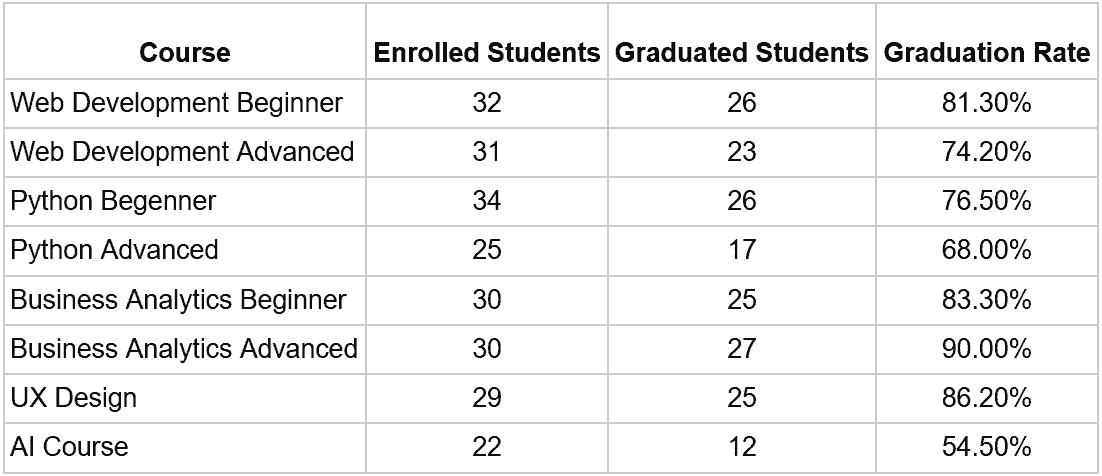
In 2025, graduation outcomes across Women in Tech courses remained strong, with most courses achieving completion rates above 70%. Higher-level and continuing courses demonstrated particularly high graduation rates, reflecting sustained student commitment as learners progress through technical pathways. Variations in completion rates across courses also provide valuable insights for ongoing curriculum refinement and student support.
Who are our students and volunteers?
Students
- 18 years of age or over
- Intermediate to advanced-level of English
- Passion for learning programming and other technical skills
- Ability to dedicate three-to-four hours a week to class, homework, and a final project
Volunteers
- Intermediate to advanced technical knowledge of the course they are applying for
- Interest in working with an international team and diverse set of students
- Ability to dedicate between three and six hours a week
- Passionate about supporting women in tech
Women in Tech: Student Projects
At the end of each course, students are expected to complete a final project that combines all the skills they have learned throughout the semester.
They research and develop their project, then present it to the Paper Airplanes staff and partners. Check out some of the projects our students have completed on the projects page.
Our Specialized Curriculum
Paper Airplanes' courses are the result of a unique collaborative effort between our dedicated volunteer tutors, mentors, and a team of Stanford students who have contributed to the development and refinement of our programs.. This diverse team of educators and subject matter experts carefully crafted a curriculum specifically designed to meet the needs of Paper Airplanes students. Through thoughtful discussion and drawing on extensive educational experience, they identified the most relevant and impactful topics across various disciplines. The resulting courses represent a balanced approach to skill-building that combines theoretical foundations with practical application, ensuring our students develop both knowledge and confidence to succeed in today's rapidly evolving professional landscape. Each course has been meticulously structured to create a seamless learning journey that progresses from fundamental concepts to advanced applications, all while remaining accessible and engaging for our unique student population.
Python 1: Foundations of Programming
Master the fundamentals of Python programming in our comprehensive beginner-friendly course.
Python 1 is designed for aspiring programmers seeking to build a solid foundation in one of today's most versatile and in-demand programming languages. This course takes you from the absolute basics to creating functional programs through hands-on practice and expert guidance.
Starting with core concepts such as data types, variables, and basic operations, you’ll quickly progress to more advanced topics, including conditional statements, loops, and data structures. Our structured curriculum ensures a logical progression as you learn to write increasingly sophisticated code. Our structured curriculum ensures a logical progression as you learn to write increasingly sophisticated code.
The course places special emphasis on Python’s powerful data structures (lists, dictionaries, tuples, and sets), providing you with the tools to organize and manipulate information effectively. You’ll master essential programming skills such as input handling, type conversion, and the strategic use of if-statements and loops for creating dynamic applications. As you advance, you’ll learn to create reusable code through custom functions, understand variable scoping, and work with external modules to extend your program's capabilities.
By the course conclusion, you’ll have practical experience with file handling for data persistence and a comprehensive understanding of Python fundamentals. You’ll master essential programming skills such as input handling, type conversion, and the strategic use of if-statements and loops to create dynamic applications. As you advance, you’ll learn to create reusable code through custom functions, understand variable scope, and work with external modules to extend your program’s capabilities
Python Intermediate: Advanced Programming & Data Science Fundamentals
Take your Python skills to the next level with our comprehensive intermediate course that bridges core programming concepts to real-world applications.
Building
directly on the foundation established in our Python 1 course, Python Intermediate elevates your programming capabilities through advanced concepts and practical applications in data science and software development. This course is designed for students who have mastered Python basics and are ready to explore the language's full potential in solving complex problems.
The journey begins with a deep dive into Object-Oriented Programming (OOP), where you'll learn to structure code efficiently through classes, inheritance, and encapsulation across two comprehensive modules. You’ll develop professional debugging skills and exception-handling techniques to write robust, error-resistant code that performs reliably in production environments.
As the course progresses, you’ll transition into powerful data manipulation with NumPy and Pandas, gaining essential skills for data analysis through two focused Pandas modules. You'll connect your applications to external data sources through database interactions and API integrations, opening countless possibilities for creating dynamic, data-driven programs.
The curriculum then introduces data visualization with Matplotlib, allowing you to transform complex datasets into compelling visual narratives. You'll connect your applications to external data sources through database interactions and API integrations, opening countless possibilities for creating dynamic, data-driven programs.These modules provide a practical introduction to building predictive models and discovering patterns in data.
The course concludes with essential developer workflow skills in command line operations and Git version control—tools used by professional developers worldwide. By completion, you’ll possess a versatile skill set spanning software development, data analysis, and machine learning fundamentals, preparing you for specialized advanced courses or immediate application in professional settings.
Business Analytics 1: Foundations of Data-Driven Decision MakingBusiness Analytics
Transform raw business data into actionable insights with our comprehensive introduction
to business analytics.
Business Analytics 1 provides a thorough foundation in the essential tools, techniques, and methodologies that drive modern data-informed business decisions. This course is designed for professionals and students seeking to develop analytical capabilities that can immediately enhance business performance and strategic planning.
The journey begins with an exploration of fundamental analytics concepts and an introduction to the diverse landscape of analytics tools and data sources available in today's business environment. You'll quickly advance to practical applications in Excel, mastering descriptive statistics techniques that form the backbone of business reporting and preliminary analysis.
Data visualization takes center stage as you learn to transform complex datasets into compelling visual narratives that effectively communicate findings to stakeholders at all levels. This skill is further enhanced through comprehensive training in Pivot Tables, enabling you to dynamically reorganize, summarize, and analyze large datasets with remarkable efficiency.
The course introduces predictive modeling through two dedicated modules on linear regression, providing you with the ability to identify relationships between variables and make data-backed forecasts. You'll develop crucial data preparation skills to ensure your analyses are built on clean, relevant information—a critical but often overlooked component of successful analytics.
Statistical rigor is emphasized through training in hypothesis testing and ANOVA, providing you with the tools to validate assumptions and make confident, statistically sound decisions. The curriculum integrates business process modeling through BPMN and flowcharting techniques, connecting analytical insights with operational improvements.
Throughout the course, you’ll apply your growing skill set to real-world case studies, solidifying theoretical knowledge through practical application. The program culminates in a comprehensive final project where you'll demonstrate your ability to address authentic business challenges through analytics. The program culminates in a comprehensive final project where you'll demonstrate your ability to address authentic business challenges through analytics.
Business Analytics 2: Advanced Data-Driven Decision Making
By completion, you'll possess a versatile analytical toolkit that can be immediately applied to drive value in any business context, while establishing a strong foundation for advanced analytics studies.
Business Analytics 2 builds directly upon the foundations established in Business Analytics 1, taking your data analysis skills to an advanced level where insights drive organizational strategy and competitive advantage. This intermediate course is designed for professionals who have mastered basic analytical concepts and are ready to implement sophisticated analytical frameworks in real-world business scenarios.
The course begins by reinforcing core statistical concepts before quickly advancing to complex data understanding and preparation techniques essential for working with diverse enterprise datasets. You'll enhance your Excel proficiency with advanced statistical calculations, moving beyond basic formulas to create dynamic analytical models that respond to changing business conditions.
Data visual narratives that effectively communicate complex insights to diverse stakeholders. The curriculum places special emphasis on comprehensive data preparation—recognizing this critical but often undervalued phase of the analytics lifecycle—with dedicated sessions on cleaning methodologies and variable transformation techniques that ensure analytical integrity.
You’ll gain a sophisticated understanding of both supervised and unsupervised modeling approaches, learning when and how to apply different analytical frameworks to various business challenges. The course provides advanced training in linear regression, exploring extensions like multiple regression, logistic regression, and time series analysis that dramatically expand your predictive capabilities.
Statistical rigor is reinforced through advanced hypothesis testing methodologies, giving you confidence in the validity of your analytical conclusions even when working with complex, multivariable datasets. The course provides advanced training in linear regression, exploring extensions such as multiple regression, logistic regression, and time series analysis that dramatically expand your predictive capabilities.
The data deployment modules represent a significant advancement beyond basic analytics, covering critical aspects of model evaluation through error analysis, accuracy metrics, and precision measurements. You’ll develop essential skills in translating technical findings for non-technical audiences—a crucial capability for ensuring that analytical insights drive actual business decisions. The integration of SWOT analysis connects your analytical work directly to strategic planning processes.
The curriculum culminates with comprehensive case studies of complete analytical workflows in real-world settings, demonstrating how the techniques you've mastered function in actual business environments. The integration of SWOT analysis connects your analytical work directly to strategic planning.
Web Development 1: Building the Foundations of Modern Web Design
Master the essential skills to create responsive, interactive websites from the ground up
Web Development 1 provides a comprehensive introduction to the fundamental technologies that power modern websites and web applications. This course is designed for beginners who want to enter the exciting field of web development, equipping you with the core skills needed to build professional web experiences from scratch.
The journey begins with HTML (Hypertext Markup Language), the backbone of all web pages. Through two dedicated modules, you'll master semantic HTML structure, learning to craft well-organized content that provides accessibility and proper structure for your web projects. From basic text elements to complex forms and media integration, you'll develop a thorough understanding of how content is structured for the web.
As your HTML skills solidify, the course transitions to CSS (Cascading Style Sheets), where you'll transform basic web structures into visually appealing designs. Across two focused CSS modules, you'll learn layout techniques, responsive design principles, and styling methodologies that ensure your websites look professional across all devices. You'll master flexbox, grid systems, and other modern CSS features that give you precise control over your web layouts.
The curriculum then introduces JavaScript, the programming language that brings websites to life with interactivity and dynamic functionality. Through three comprehensive JavaScript modules, you'll progress from basic syntax and concepts to creating interactive elements, form validation, and dynamic content updates. You'll learn how to respond to user actions, manipulate the DOM (Document Object Model), and create engaging user experiences that go beyond static pages.
Version control through Git is integrated into the course, teaching you industry-standard workflows that enable collaboration and code management—essential skills for professional web development. The learning experience culminates in a hands-on project phase where you'll apply all acquired skills to build a complete website from concept to deployment.
The course concludes with Demo Day, a showcase opportunity where you'll present your project, demonstrating both technical proficiency and your unique creative approach to web development challenges. By completion, you'll possess a versatile skill set in the core web technologies, positioning you for continued growth in advanced web development or immediate application in creating professional websites.
Web Development 2: Mastering Full-Stack Development
Elevate your web development skills from front-end basics to comprehensive full-stack expertise. By completion, you’ll possess a versatile skill set in core web technologies, positioning you for continued growth in advanced web development or immediate application in creating professional websites. This intermediate-level course is designed for those who have mastered HTML, CSS, and basic JavaScript, and are ready to explore the complete web development ecosystem spanning front-end, back-end, and database technologies.
The course begins with a comprehensive overview of the full-stack development landscape, introducing the interconnected components that power modern web applications. You'll immediately engage with an ambitious goal project that serves as the course's north star, providing context for each technology and technique as you progressively build a complete web application from concept to deployment.
Version control takes center stage early with advanced Git training, teaching you professional collaboration workflows and branching strategies essential for development teams. With this foundation in place, you'll revisit and significantly extend your front-end development skills across three intensive modules that deepen your mastery of HTML, CSS, and JavaScript. These sessions focus on advanced techniques for creating responsive, interactive user interfaces that communicate seamlessly with back-end services.
The curriculum then introduces database design and implementation, where you'll learn to model, store, and manipulate application data through CRUD (Create, Read, Update, Delete) operations. You'll gain hands-on experience designing database schemas and implementing data persistence for your applications.
Back-end development forms a substantial portion of the course, beginning with server fundamentals and progressing through three comprehensive modules that teach you how to create robust APIs, handle user requests, process data, and communicate with databases. You'll learn to build the invisible but critical infrastructure that powers web applications, connecting your front-end interfaces to persistent data storage.
The course incorporates modern development methodologies through training in agile project planning, preparing you for real-world environments where iterative processes and team collaboration are essential. All acquired skills culminate in a final project phase where you’ll build and deploy a complete full-stack application, demonstrating your ability to integrate diverse technologies into a cohesive and functional product.
By course completion, you will possess a comprehensive understanding of the entire web development stack, with practical experience in each layer, from user interface to database management. This versatile skill set positions you for specialized roles in front-end, back-end, or full-stack development, enabling you to build sophisticated web applications that solve real-world problems.
UX Design: Creating Human-Centered Digital Experiences
Master the essential principles, tools, and methodologies of modern user experience design
Our comprehensive UX Design course equips aspiring designers with the complete skill set needed to create intuitive, accessible, and engaging digital products. This course bridges theory and practice through a carefully structured curriculum that progresses from foundational concepts to advanced implementation techniques.
The journey begins with the core principles of user experience design, where you'll explore the psychology of digital interaction and develop the empathy essential for creating user-centered solutions. You'll master the design thinking methodology—a proven framework for solving complex user problems—while learning to recognize and mitigate biases that can affect research quality and design decisions.
As your understanding deepens, you'll develop practical skills in user research, learning to craft effective interview questions, build representative personas, and map comprehensive user journeys that identify critical opportunities for improvement. These insights will guide you through the process of defining clear problem statements and value propositions that serve as the foundation for innovative design solutions.
The course transitions from conceptual to visual through training in wireframing and prototyping. You’ll learn to create low-fidelity wireframes that communicate core functionality by applying Gestalt principles and ethical design considerations while avoiding deceptive patterns. Figma, the industry-standard design tool, features prominently in your learning experience, giving you hands-on practice with professional software used in design studios worldwide.
User testing methodologies form a crucial component of the curriculum, teaching you to validate design decisions through structured research with diverse participants. Figma, the industry-standard design tool, features prominently in your learning experience, providing hands-on practice with professional software used in design studios worldwide.
As your skills advance, you’ll create high-fidelity mockups and interactive prototypes, mastering the nuanced elements of visual design, including typography, color theory, accessibility considerations, and spatial relationships. You'll learn to implement established design patterns while maintaining the creative flexibility to solve unique design challenges.
The course culminates with portfolio development and job preparation, where you'll create a compelling showcase of your design projects, develop your personal brand, and prepare for the UX design interview process. You’ll learn to implement established design patterns while maintaining the creative flexibility needed to solve unique design challenges.

What Our Students Are Saying:
As someone not in the tech field, the UX Design course was never challenging because of the support of my instructors and peers.
creativity is required in UX Design alongside with all industries, and this course presented the underlying science behind it in a decent way to be accessible for all of us.
I want to show my gratitude to the Women in Tech team that puts continuous efforts into creating change in women's lives and society.
Noor Abou saab

What Our Students Are Saying:
Taking Microsoft courses was truly enlightening for me. The structured curriculum and diversity subjects allowed me to delve into various Microsoft tools and technologies, enhancing my technical skills. The instructors were knowledgeable and supportive, providing valuable insights and practical tips. Overall, the courses provided me with a solid foundation and practical skills, making it a highly rewarding experience.
Nada Masarweh

What Our Students Are Saying:
Enrolling in the Microsoft course was the best decision I made, I have gained an understanding of how these software works and what you can do with them. This course has equipped me with the best essential skills, which will benefit me when I enter the workplace and also in my day-to-day life. I am interested in the computer science field, so knowing how to use Excel will come in handy.
Nawal Al sharif

What Our Students Are Saying:
I found the Microsoft courses to be incredibly informative and well-structured. The content is up-to-date and relevant, making it easy to apply what I've learned directly to my work. The interactive elements and practical exercises were particularly helpful in solidifying my understanding. Overall, these courses are a valuable resource for anyone looking to enhance their skills.
Leen Al Halabi
Veteran Tutors
Click on their photos to learn more about their experiences.


FAQs
Students
Is there a set curriculum?
Yes. the curricula for all of our courses are created by volunteers who have experience in the topic. The WiT curriculum is re-evaluated after each semester and new technology and concepts are integrated to improve the curriculum every year.
How are students assessed on competency?
Students will participate in classwork and be assigned homework after each lesson. While we do not grade students’ work with a letter grade, we encourage students to work hard and we assess their skill level through the completion of each assignmen. Their competency overall is assessed on Demo Day, when they complete a final project and present it to our partners and staff.
Are there opportunities for students to grow their skills outside of the classroom?
Yes! In addition to the courses, WiT hosts several professional development workshops and competitions throughout the year. Our most recent hackathon was conducted in partnership with Expedia. Check out our social media pages and websites for more details!
How often do peer mentors and students meet?
It is up to the student how many times they would like to meet with their assigned volunteer tutors or mentors. While the class times will be flexible, students are required to attend at least 70% of instructional classes. Extra support from mentors is available should they need it.
What is the time commitment?
Students are expected to dedicate two to three hours a week to the course. Students spend one hour in class, one hour on homework, and one additional hour getting help from a mentor during office hours should the student need it.
FAQs
Volunteers
What is the time commitment?
The time commitment is four to six hours a week for tutors and two to four hours a week for mentors. Tutors will be provided with the curriculum, and it is their responsibility to prepare for lessons, present the class content, and keep up with student attendance and progress. The mentors assist and collaborate with the tutors to ensure that students have all the resources they need to be successful.
What are the requirements for me to volunteer?
Tutors and mentors are required to have working knowledge of the skill(s) taught in their chosen course. However, they do not have to be experts, as many of these classes are for beginners. Tutors and mentors must also be willing to collaborate with an international team and dedicate enough time to the program.
How do volunteers interact with the students?
We use a combination of communication tools to interact with students between classes, including WhatsApp, Slack, and email. After onboarding tutors and mentors through our training program, we provide them with all the information needed to communicate with students.
Do tutors have to create the homeworks and classwork?
No. The curriculum, along with classwork and homework, will be provided to tutors. Although tutors are free to develop additional resources, they are only required to use the material given for each course.
Do volunteers have to live in a specific time zone?
No. The strength of our program lies in the fact that it is conducted virtually. It is flexible, so tutors can reach out to the students and set a time that works best for both of them each week.
Want to hear our news?
Subscribe to our newsletter.


